 The Sabrina Foundation
Patient Story
Imelda's Story
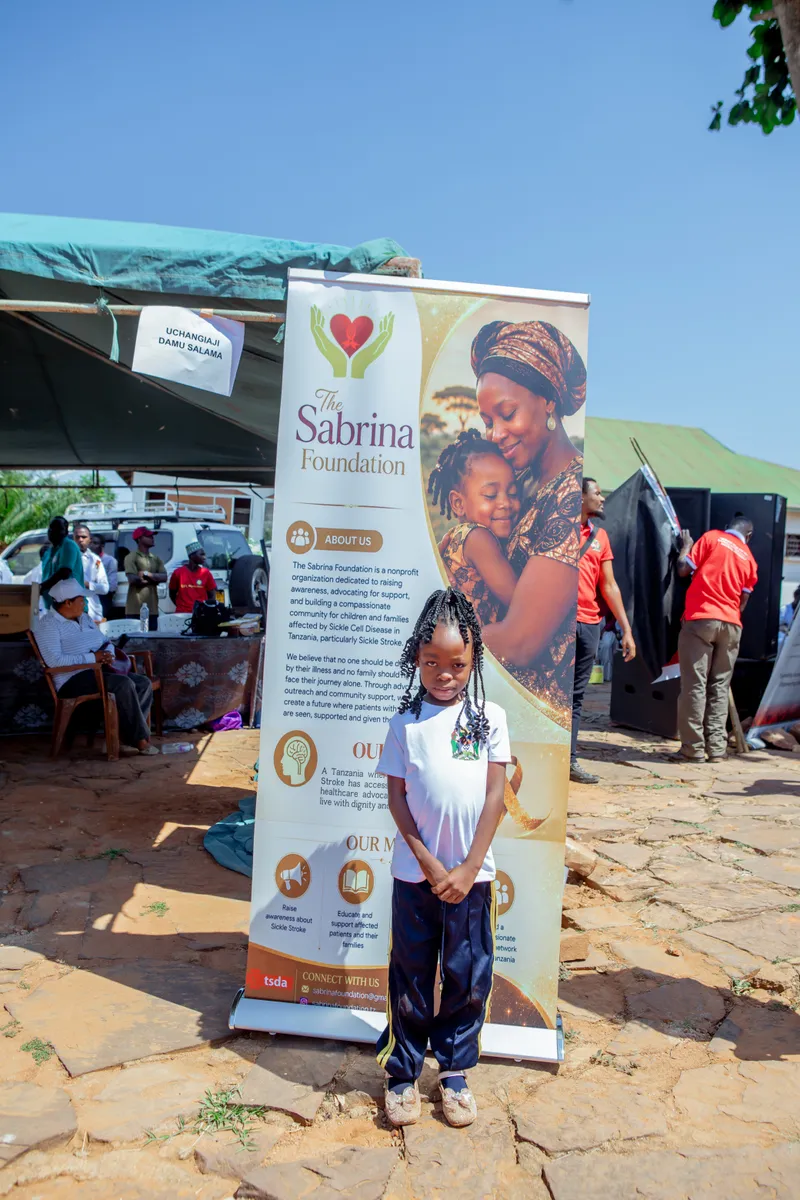
Imelda Florence Makoa is nine years old. She lives in Msimba, Kigoma, with her parents and her two-year-old brother Issa — who also has Sickle Cell Disease. Together, they are a family that knows this illness from every angle.
The Stroke Nobody Named
When Imelda was four months old, her mother Zena noticed something wrong. Her limbs were weak. Her development didn’t look right. Zena took her to Maweni Hospital in Kigoma, where doctors confirmed she had suffered a stroke and immediately performed a blood transfusion.
But the stroke left Imelda needing a leg cast — a service Maweni did not offer. The family had to travel to the Comprehensive Community-Based Rehabilitation in Tanzania (CCBRT) in Dar es Salaam to get it. The cost was not covered by their insurance. They went anyway.
Despite all of this, it wasn’t until Imelda was eighteen months old that she received her Sickle Cell Disease diagnosis. Fourteen months of treatment, travel, and fear — before anyone named what they were dealing with.
She wore the leg cast until she was four. Today, her right arm and hand remain significantly weaker and partially numb. She attends regular physiotherapy to maintain the function she has. She will likely need it for the rest of her life.
The Cost of Staying Well
Until recently, the family’s National Health Insurance Fund (NHIF) package — which cost 425,000 Tanzanian shillings — covered hydroxyurea for Zena, Imelda, and Issa. When they renewed at the start of 2026, they found out hydroxyurea had been removed from their package — and the new insurance plan that covers it costs 972,000 Tanzanian shillings.
Hydroxyurea is not optional. Both children need three capsules each day. At the retail price of 1,500 Tanzanian shillings per capsule, that is 9,000 shillings a day — 270,000 shillings a month — just for medication. It is far beyond what the family can afford. Zena sells fruit. Her husband drives a motorcycle taxi.
Bullied Out of School
Sickle Cell Disease is widely misunderstood in the Kigoma region. At the local government school Imelda first attended, she was bullied by both students and staff. Teachers subjected her to physical punishment despite her condition. The environment was not safe.
Her parents enrolled her at Bishop Mlola School — a Christian school about thirty minutes from their home that offers a more supportive atmosphere. It costs 1.1 million Tanzanian shillings a year in tuition. There are times when the family cannot pay the full amount, and Imelda misses weeks of school at a stretch.
Looking Forward
None of this has broken Imelda’s spirit. She continues her physiotherapy. She goes to school when she can. She has one goal: to become a doctor when she grows up.
Her story is not unusual in Tanzania. It is the story of what happens when a child survives — but the systems around her don’t keep up.
Make a Difference
Every child deserves a fighting chance.
Your support helps us reach more families, fund awareness campaigns, and stand beside children like Imelda Florence Makoa.